
Start here
How to start a crack filling business
7-minute read · Figures checked October 2026
Photo: Plato Terentev / Pexels, Pexels License
The short answer
Learn to read cracks first. Cracks that move get sealed with specialized material, cracks that barely move get filled with ordinary material, and broken-up pavement needs repair instead. Start with one material and the equipment that matches it, learn it beside an experienced operator, and clean and dry every crack. Hot-pour work means hot kettles, open flame and fuel, so get the safety gear before the first job. The money and setup steps are in Business 100: Start Right, and the start hub has the full launch sequence.
Filling or sealing: know which job you're doing
A crack manual from the Federal Highway Administration (FHWA) draws the line this way:
- Crack sealing places specialized material into or over working cracks, to keep out water and grit.
- Crack filling places ordinary material into non-working cracks, to cut down the water getting in.
A working crack opens and closes as temperatures change through the year. FHWA's manual makes yearly horizontal movement the main test, with a little under 1/8 inch (3 mm) as the dividing line. Transverse cracks from temperature swings are typical sealing candidates. Diagonal cracks, most longitudinal cracks and some block cracks usually don't move much, so they get filled. FHWA's criteria also look at width: roughly 3/16 to 3/4 inch for sealing, and up to about 1 inch for filling.
Know when to walk away. FHWA's manual calls crack sealing or filling uneconomical and technically unsound when a lot has a large number of cracks or badly broken-down ones. Its guidelines send badly broken cracks to repair, like patching, and widespread broken cracking to rehabilitation. Recommend the repair or refer it out (B100.3).
Example. Keisha (example) walks a church lot. Long cracks with tight edges run straight across it: sealing candidates. In one corner, the pavement has cracked into small blocks with broken edges. She quotes sealing for the long cracks and refers the corner to a paving contractor for patching.
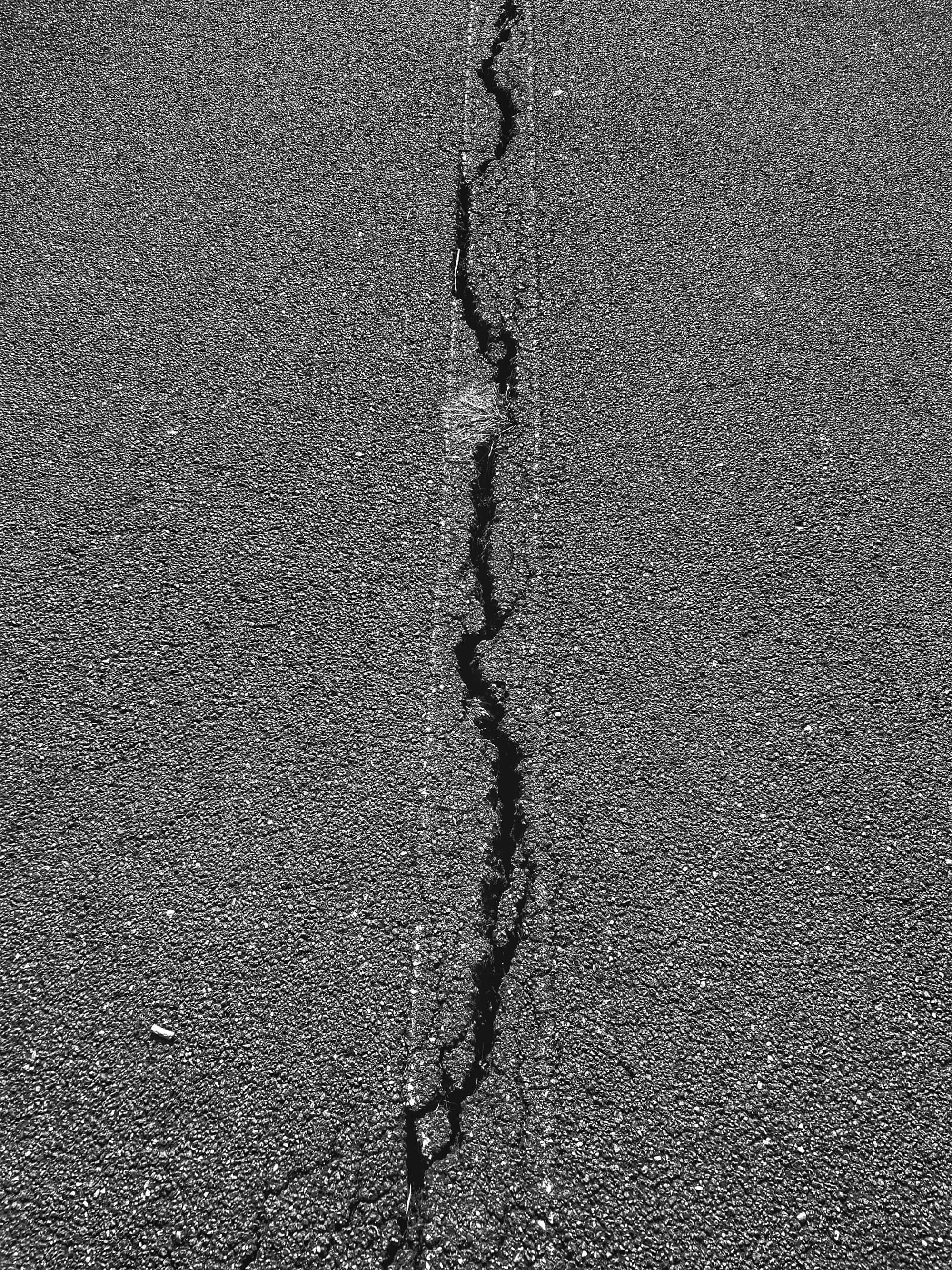
An open crack before sealing. Water gets in here and weakens the base.
Photo: Emanuele Borri / Pexels, Pexels License
Hot-pour or cold-pour
FHWA's manual sorts crack materials into three groups:
| Group | Examples | Mostly used for |
|---|---|---|
| Cold-applied | Asphalt emulsions, polymer-modified liquid asphalt | Filling |
| Hot-applied | Asphalt cement, fiber-modified asphalt, rubberized asphalt | Filling; rubberized types mostly sealing |
| Chemically cured | Self-leveling silicone | Sealing |
Cold-applied material goes on without a melter. Hot-applied material needs a melter that matches it. FHWA's manual says direct-heat kettles aren't suitable for rubber- or fiber-modified materials. Those need an indirect-heat kettle with an agitator, where heated oil surrounds the melting vat, a method FHWA calls safer and more controlled. Buy the material and the machine together, and read the material's data sheet for its heating range, compatible equipment and weather limits.
The equipment, by job:
- Cleaning: an air compressor with a wand, a hot-air lance, or wire brushes.
- Cutting: a router or crack saw, if you'll seal working cracks.
- Applying: an applicator for cold-pour, or for hot-pour a melter-applicator or a trailer kettle with a wand; a squeegee to strike off or shape the band.
- Safety: the gear listed below, a fire extinguisher, cones and signs.
Rent what you'll use only a few days a season (B100.4).
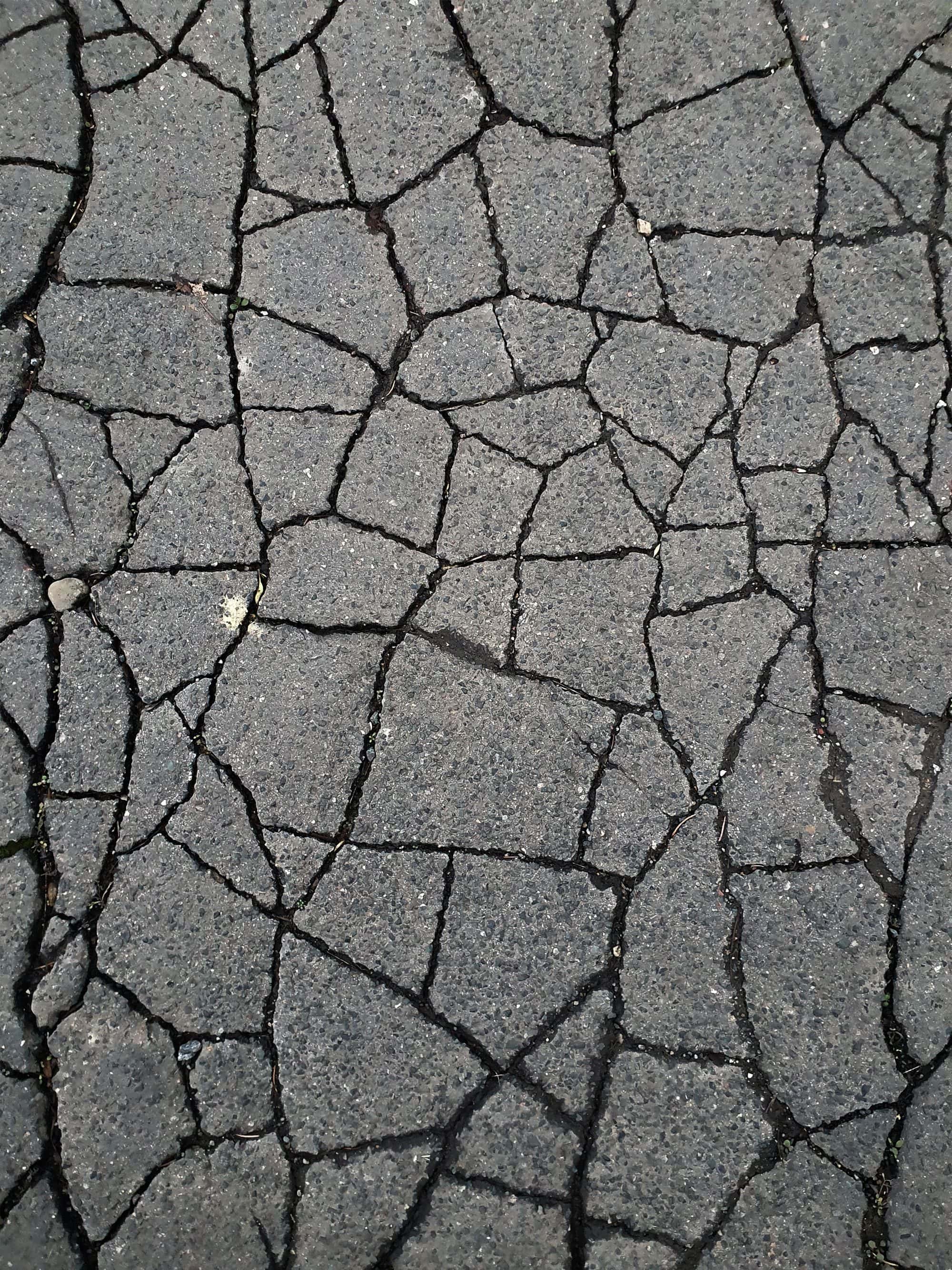
Alligator cracking: the surface has broken into blocks. This usually needs a patch, not crack sealant.
Photo: Daniel Kružík / Pexels, Pexels License
Prep: routing, cleaning and drying
FHWA's manual says a high share of crack treatment failures are adhesion failures caused by dirty or damp cracks. So:
- Routing cuts a neat reservoir centered over the crack with a router or saw. FHWA says it's often done for sealing and rarely for filling.
- High-pressure air blows out dust and debris, but it doesn't dry the crack well.
- A hot-air lance cleans, dries and warms the crack, which helps hot material bond. Keep it moving: FHWA warns it can burn the pavement, and says direct-flame torches should never be used.
- Wire brushing is only for cracks that are already dry and nearly clean.
Then place the material flush with the surface, in a band over the crack (an overband), or inside a routed reservoir, as the product and the job call for.
Routing and sawing throw dust and chips, so wear eye protection. If you'll cut or grind, ask the Occupational Safety and Health Administration (OSHA) consultation program whether its silica rule for construction applies.
Safety around hot material
The Pennsylvania Department of Transportation's Local Technical Assistance Program safety sheet on hot liquid asphalt covers crack sealing crews:
- Gear: head protection with a face shield, safety glasses, a long-sleeved shirt and leather gloves, plus an apron for wand, loading and kettle operators.
- Fire: a fully charged extinguisher rated for burning oil, close at hand. Never heat in an enclosed area, and park the machine outside before lighting it. If material overflows or spills, shut off the burners.
- Material: keep water out of the machine, and never add kerosene or diesel to the sealant.
- Burns: cool the burn with cold water, not ice. Don't pull the asphalt off the skin. Get medical help right away.
OSHA's construction rules call for an extinguisher rated at least 10B within 50 feet of wherever more than 5 pounds of flammable gas, such as propane, or more than 5 gallons of flammable or combustible liquid is in use. OSHA lists headache, skin rash, eye and throat irritation, cough and skin cancer among the effects of asphalt fumes, so work upwind when you can. When other controls fall short, employers must provide personal protective equipment (PPE) and train each worker to use it.
Season, customers and first jobs
FHWA's manual puts crack sealing in spring or fall, when it's moderately cool and the cracks are partly open, and says filling often happens in cool weather. That fits around a summer sealcoating season.
Your customers are the same people who buy sealcoating (B100.3). Crack work sells on its own and as the step before sealcoating (see the sealcoating guide).
Learn on someone else's crew. Ask your supplier what training comes with the machine, and have an experienced operator watch your first jobs. Then finish three paid jobs before you buy a bigger kettle (B100.3).
Licensing depends on your state, county and city, says the U.S. Small Business Administration. Get insurance before the first paid job, and tell the agent you'll run open flame and hot material (B100.7). You can start with weekend jobs while you keep your paycheck (B100.1). Report every dollar, cash included, as the IRS requires.
Your Move
Do this week
- Walk three lots near you. Sort what you see into cracks to seal, cracks to fill and areas that need patching.
- Pick one material and get its data sheet and safety data sheet (SDS). Note its heating range, equipment and weather limits.
- Ask a supplier or an experienced operator to show you the machine that matches it, and what training comes with it.
- Price the safety gear and a fire extinguisher before you price the melter.
Log it: I sorted the cracks on three lots.
Frequently asked questions
What's the difference between crack filling and crack sealing?
Sealing places specialized material into or over cracks that move. Filling places ordinary material into cracks that barely move. FHWA's manual uses a little under 1/8 inch of yearly movement as the dividing line.
Should I start with hot-pour or cold-pour crack filler?
Cold-pour needs no melter, so it takes less equipment. Hot-pour takes a matching melter, training and safety gear, and FHWA's manual pairs rubberized hot-pour mostly with sealing.
Do I need to rout cracks before I seal them?
Not always. FHWA's manual says routing is often done for sealing and rarely for filling. Follow the job's spec and the product's instructions.
What equipment do I need to start crack filling?
Cleaning tools, an applicator that matches your material, a squeegee, safety gear, a fire extinguisher, and cones and signs. Budget for all of it (B100.4).
Which cracks shouldn't I fill?
Lots covered in cracks, or cracks that are badly broken down. Recommend repair there, such as patching, or refer the job out.
Watch out for
- A melter that doesn't match your sealant.
- Filling damp or dirty cracks.
- Heating cracks with an open-flame torch.
- Running a kettle with no extinguisher on site, or with a crew that isn't geared up.
- Selling crack filling as a fix for broken-up pavement.
Free help
- FHWA: Materials and procedures for sealing and filling cracks in asphalt-surfaced pavements
- PennDOT LTAP: Safety with hot liquid asphalt
- OSHA On-Site Consultation: no-cost, confidential safety help for smaller businesses
- Small Business Development Centers: no-cost business consulting
- SCORE: free, confidential mentoring
Related guides
This is general education, not tax, legal, investment or insurance advice. Rules change and every situation is different. Check the sources below, and talk to a qualified professional before you act on it.
Sources
- FHWA: Materials and procedures for sealing and filling cracks in asphalt-surfaced pavements: manual of practice (FHWA-RD-99-147)
- Pennsylvania Department of Transportation, LTAP: Technical Information Sheet #178, Safety with hot liquid asphalt (Summer 2016)
- OSHA: 29 CFR 1926.150, fire protection; Asphalt (bitumen) fumes; Personal protective equipment; Silica, crystalline: construction; On-Site Consultation
- U.S. Small Business Administration: Launch your business
- IRS: Filing tips and updates for gig economy workers