
Lesson B102.5 · Business Finance 102: Bank-Ready
Equipment: rent, buy used, buy new or finance
5-minute read · Figures checked October 2026
Photo: Anamul Rezwan / Pexels, Pexels License
The short answer
Rent until the numbers say own. Work out what a machine would cost you per productive hour and how many days a year you'd really use it. If you'd use it fewer days than the break-even, keep renting. When owning wins, buy used with cash if you can. If you'd have to finance it, the payment has to fit your slowest months and the deal has to pass all five Borrowing Rules.
Before you buy the iron, run the numbers
A machine you own costs money whether it runs or not. Fixed costs are the value it loses each year, insurance, registration, storage, the repairs that come with age, and interest if you borrow. Running costs are fuel, wear parts and grease, paid only when it works.
Cost per productive hour = yearly fixed costs ÷ productive hours + running cost per hour.
Productive hours are hours doing work on a job, not hours on the trailer or waiting out rain.
Example (made-up numbers). Ray is looking at a used skid steer for $36,000. He figures he'd sell it in six years for about $12,000, so it loses about $4,000 a year. Add $1,000 a year for insurance, registration and storage, and $2,000 for repairs and maintenance: $7,000 a year to own. He'd use it about 35 days a year at 6 productive hours a day, or 210 hours. $7,000 ÷ 210 = about $33 an hour, plus about $9 an hour for fuel and wear parts: about $42 per productive hour. That's his cost, not a price to charge.
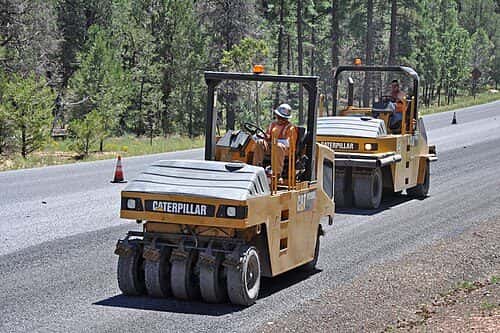
Rubber-tired rollers on a road job: the kind of machine owners weigh renting against buying.
Photo: Grand Canyon National Park / Wikimedia Commons, CC BY 2.0
.jpg)
Rent or own: the break-even in days
Break-even days = yearly cost to own ÷ rental cost per working day.
Use the weekly or monthly rate you'd really pay, with delivery. Day rates cost the most per day, so comparing against them makes owning look better than it is.
Example (continued). Ray's rental yard quotes $1,250 a week with delivery, or $250 per working day over a five-day week. $7,000 ÷ $250 = 28 days. At 35 days a year, renting costs 7 weeks × $1,250 = $8,750, so owning saves about $1,750 a year on paper. At 20 days a year, renting costs $5,000 and owning still costs $7,000, so renting costs about $2,000 less on paper.
Then come the questions the math can't answer. Was 35 days a real count or a busy-year guess? Where does it sit all winter? When your own machine breaks down mid-job, who brings a replacement? And would the $36,000 come out of your winter reserve?
Buying used
- Have a mechanic you trust look it over before you pay: hours, leaks, wear on pins and bushings, tires or tracks.
- Ask for service records, and make sure parts and service are close by.
- Get proof it's paid off, and check for liens before money changes hands. A lender's lien can follow the machine to you.
- Get the title or a signed bill of sale.
If you'd have to finance it
Run all five Borrowing Rules (B102.3). In a seasonal business, rule 3 is the one a busy year can hide: the payment has to fit your slowest months, not your best ones.
Example (made-up numbers). Financing Ray's $36,000 machine at an example 9% over three years means a payment of about $1,145 a month, with about $5,200 of interest added to the cost of owning. In January, with no work, the payment still comes out. Four winter payments are about $4,580 that has to be saved before the snow flies.
A tax deduction doesn't make the machine free. Section 179 and bonus depreciation can let you deduct the whole price in the year you buy. But a deduction saves only your tax rate times the amount. At a combined rate of 30% (example), deducting $36,000 saves about $10,800 in tax, and you're still out $25,200. A big write-off also shrinks the profit on the return a lender reads (B102.3).
Two paths: keep renting or buy the machine
Two ways to go
Keep renting a machine, or buy one of your own?
Conservative path
Keep renting
Pay only for the days the machine works, at the weekly or monthly rate with delivery.
- Cash
- No purchase, and no cost on the days it doesn't run. Upkeep is the rental yard's job.
- Risk
- The rental isn't there the week you need it, and the rent adds up if your days grow.
- Time
- Booking and delivery for each job.
- What goes wrong
- Your real days pass the break-even and you keep paying more to rent than owning would cost.
Bolder path
Buy the machine
Own it: used with cash if you can, or financed if the deal passes all five Borrowing Rules.
- Cash
- Fixed costs every year whether it runs or not: lost value, insurance, registration, storage and repairs, plus interest and a payment if you finance.
- Risk
- The days you counted were a busy-year guess, and the payment still comes out in January.
- Time
- It's there when you need it, and storage, repairs and a backup plan for breakdowns are yours.
- What goes wrong
- The purchase comes out of the winter reserve, or the machine sits more days than you planned.
When each fits
Renting fits when you'd use the machine fewer days a year than the break-even, or when the day count is still a guess. Buying fits when a real count of days passes the break-even, the money doesn't come out of your winter reserve, and any payment fits your slowest months. In the lesson's example, Ray's break-even is 28 days. At 35 days a year, owning costs about $1,750 less on paper; at 20 days, renting costs about $2,000 less. The paper math leaves out your reserve, your slowest months and how sure the day count is.
Different approaches
Where respected teachers differ
Ramsey's EntreLeadership teaches that the right amount of business debt is zero: build cash, be your own line of credit, and pay cash, rent or buy used for equipment. Many owners finance equipment under strict rules. The National Pavement Maintenance Contractors Association (NPMCA) teaches cash-first, and if you borrow, the five Borrowing Rules.
Your Move
Do this week
- Pick the next machine you've been thinking about.
- Add up its yearly cost to own: value lost each year, insurance and storage, repairs, and interest if you'd borrow.
- Get the weekly or monthly rental rate with delivery, and figure your break-even in days with the Equipment decision tool or a calculator.
- Count the days you actually used or rented one last season, and compare.
- If you'd finance it, check the payment against your slowest weeks in the 13-week forecast.
Log it: Rent-versus-own run.
Common questions
Is it better to rent or buy equipment?
It depends on your days, your cash and your slowest months. Below the break-even, renting usually costs less on paper. Above it, owning can cost less, especially bought used with cash, as long as it doesn't drain your winter reserve.
Should I buy new or used?
Used costs less up front. New comes with a warranty and fewer surprises. Either way, price the parts and service before you buy.
Does Section 179 make equipment free?
No. A deduction saves only your tax rate times the price. At a combined 30% rate (example), a $36,000 machine still costs you about $25,200.
Watch out for
- Comparing the cost of owning with day rates.
- Buying for your busiest week of the year. A machine sized for your biggest job sits idle the rest of the time.
- "Zero down, low payment" offers that stretch the term past the machine's working life (B102.6).
- Buying in December to cut taxes. If you wouldn't buy it in June, the deduction doesn't change that.
Free help
- Small Business Development Centers: free help running rent-versus-buy numbers (find your SBDC).
- SCORE: free mentoring from owners who've made these calls (score.org).
Free practice
Lesson check
5 questions on this lesson, one at a time, with the answer and the reason after each. Pass with 4 right, including every must-know question.
This is general education, not tax, legal, investment or insurance advice. Rules change and every situation is different. Check the sources below, and talk to a qualified professional before you act on it.
Sources
- IRS: Revenue Procedure 2025-32 (Section 179 for 2026); Notice 2026-11 (bonus depreciation) (checked October 11, 2026)
- Ramsey Solutions: 7 Tips for How to Run a Business Debt-Free (checked October 11, 2026)
- America's SBDC: Find your SBDC; SCORE: score.org (checked October 11, 2026)